




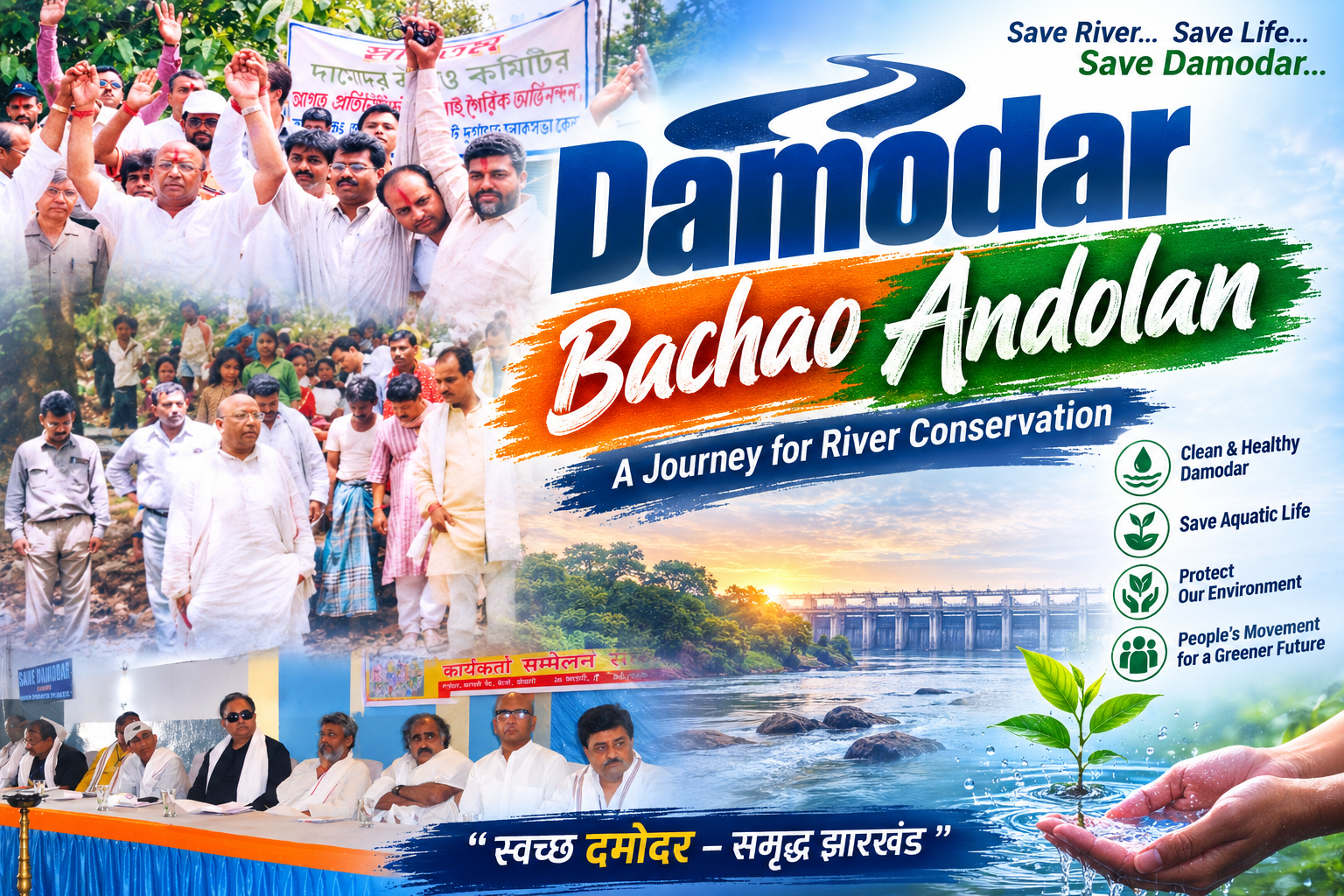
The Damodar Bachao Andolan (Save Damodar Movement) has emerged as a sustained environmental initiative aimed at the conservation and restoration of the Damodar River. The campaign brings together scientific assessment, public participation and environmental advocacy to address rising pollution levels and ecological degradation in the river system.
The movement operates on two parallel tracks—mass awareness programmes such as rallies, public meetings and seminars, and field-based scientific studies involving experts, environmentalists and civil society representatives to identify practical solutions for improving the river’s health.
Initiative Launched in 2004
The initiative gained structured momentum in 2004 when Sri Saryu Roy, then a member of the Jharkhand Legislative Assembly, initiated a detailed assessment of the Damodar River’s environmental condition. The study focused on water quality, aquatic biodiversity and pollution load across different stretches of the river.
Around the same time, Yugantar Bharati expanded its focus on environmental issues, recognizing the growing ecological concerns in Jharkhand. The organization, along with other NGOs, decided to undertake a comprehensive river journey from the Damodar’s origin to its downstream stretch in Kolkata.
Historic Damodar Yatra Conducted in 2004
A landmark expedition was launched on May 29, 2004, from Chullhapani in the Bodha Hills near the Latehar–Lohardaga border, marking the origin of the Damodar River. The journey concluded in Kolkata on June 5, 2004, covering key industrial, mining and rural stretches along the river.
The expedition was led by Sri Saryu Roy, while the scientific assessment team was headed by Prof. R.K. Sinha of Patna University. The team included environmental activists and volunteers such as Sri Rakesh Bhasker, Sri Manoj Singh, Sri Ganesh Reddy and Sri Niranjan Singh.
The primary objective of the yatra was to combine field-based water sampling with direct interaction with local communities affected by river pollution.
Day-wise Progress of the 2004 Expedition
Day 1: Origin Point at Chullhapani
The team began its journey from Ranchi on May 28, 2004, reaching Chandwa in Latehar district before proceeding to the river’s origin. Public meetings were held at Bodha village, where local residents participated in discussions on river conservation.
At the source of the Damodar, the team conducted ceremonial observations and collected the first water sample. The expedition then moved through Lapra and Dakra, concluding the day with a halt at the CCL VIP Guest House.
Day 2: Industrial and Mining Belt
On May 30, the team travelled through Macluskiganj, Piparwar, Urimari and Patratu. Water samples were collected from key locations including Marangdahi and Piparwar.
Public meetings highlighted concerns related to coal mining and industrial pollution affecting the river basin.
Day 3: Patratu to Ramgarh
On May 31, sampling was conducted at the PTPS ash pond and the Nalkari–Damodar confluence. The team later held a seminar at Ramgarh before proceeding to Rajrappa for the night halt.
Day 4: Rajrappa to Bokaro Region
On June 1, the expedition covered Tenughat Dam, Tenughat Thermal Power Station and BTPS ash pond. Public meetings were held in Gomia and Bokaro, followed by a seminar at Phusro.
Day 5: Dhanbad–Sindri Belt
On June 2, the team moved through Chandrapura, Dugdha and Dhanbad, collecting samples at Telmachho Bridge and Birsa Bridge. A seminar was held at Sindri focusing on industrial pollution concerns.
Day 6: Panchet and Maithan
On June 3, water samples were collected at Baliapur and Panchet Dam. A seminar was organized at the DVC Recreation Club, Panchet.
Day 7: Journey to Kolkata
On June 4, the team travelled through Durgapur and Burdwan, collecting samples at a DVC thermal power station before reaching Kolkata. A concluding seminar was held at Mahajati Sadan.
Post-Yatra Advocacy Efforts
Following the 2004 expedition, Yugantar Bharati submitted detailed memoranda to the Governor and Chief Minister of Jharkhand, along with relevant government departments and public sector units, highlighting concerns related to river pollution and ecological degradation.
Review Yatra Conducted in 2016
A follow-up Review Yatra was conducted in 2016 to reassess the condition of the Damodar River and compare environmental changes over the years. The journey began on May 29, 2016, from Dhanbad.
Day 1: Dhanbad–Chandrapura Region
The team visited several industrial and mining sites including Jharia, Chasnala, Sudamdih and Pathardih, and held discussions with local stakeholders before halting at Chandrapura.
Day 2: Industrial Wastewater Assessment
The second day focused on pollution sources such as DVC ash ponds, Kargali washeries, CCL discharge points and Tenughat Thermal Power Station. The day concluded at Lalpania.
Day 3: Ramgarh and Rajrappa Belt
The team visited Lalpania Dam, Rajrappa confluence, Ramgarh and Domuhani, assessing river conditions across multiple tributaries and industrial zones.
Day 4: Piparwar Region
The final day included continued assessment around Piparwar and surrounding areas, concluding the review expedition.
Science and Public Participation at the Core
A key feature of the Damodar Bachao Andolan is its integration of scientific research with community engagement. While water testing provides measurable environmental data, public interactions reflect the lived experiences of communities dependent on the river.
The movement emphasizes that river conservation requires coordinated action from scientists, local communities, industries, policymakers and environmental organizations.
Environmental Significance of the Damodar
The Damodar River plays a crucial role in supporting agriculture, industry and domestic water needs across Jharkhand and West Bengal. However, mining activities, industrial discharge and untreated wastewater have placed significant stress on its ecosystem.
The movement highlights the urgent need for pollution control, ecological restoration, continuous monitoring and sustainable development practices in the river basin.
Conclusion
The Damodar Bachao Andolan continues to function as a long-term environmental campaign focused on restoring the health of the Damodar River. The 2004 expedition and the 2016 review together underline the importance of sustained monitoring and public participation in river conservation.
The movement reinforces a clear message: safeguarding the Damodar is essential not only for environmental balance but also for the well-being of millions who depend on its waters.
